New Conflict detection across meetings

The decisions your team actually made.

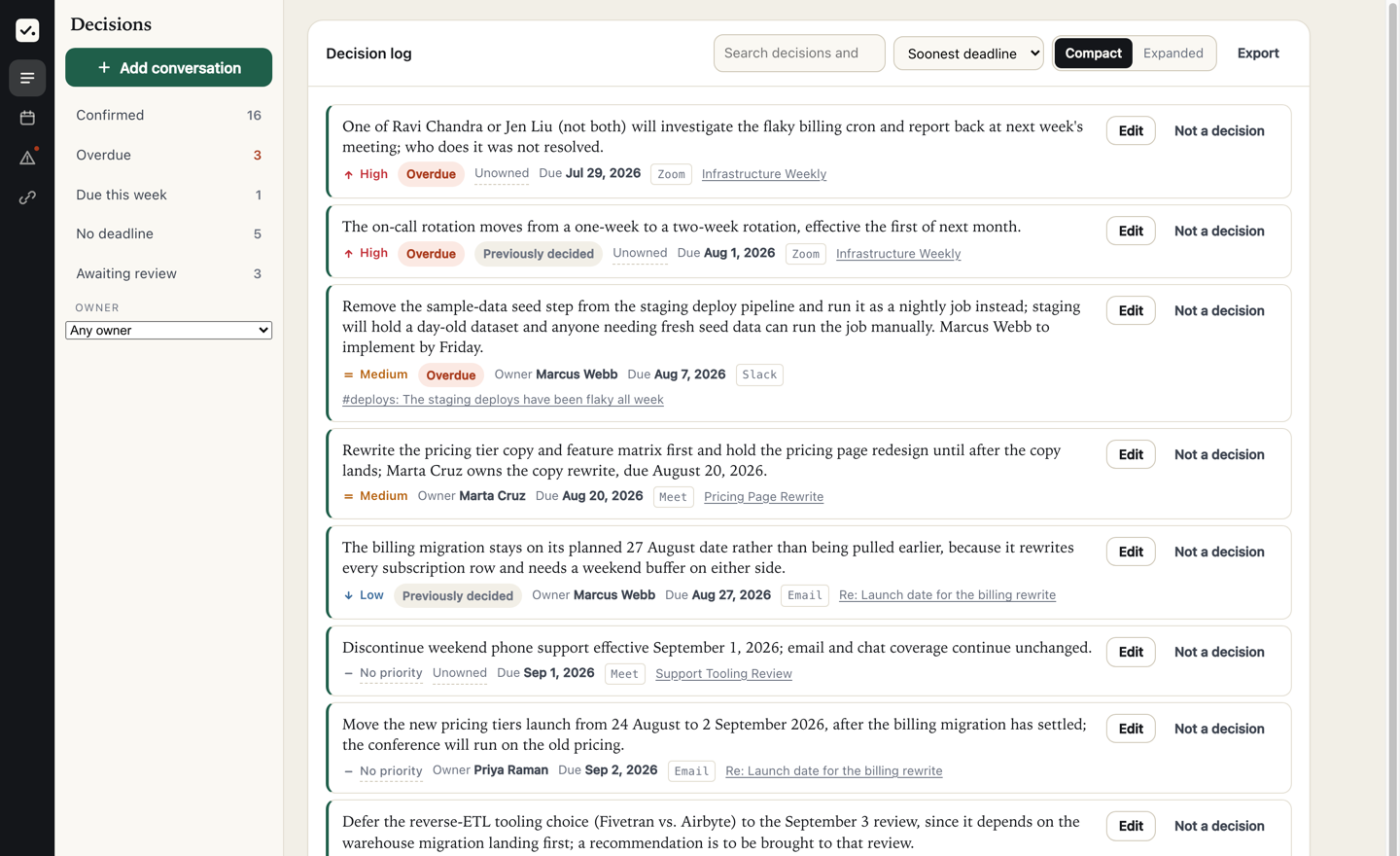
Ledger reads your Zoom and Google Meet transcripts and extracts the decisions — not notes, not summaries — with the owner and the deadline attached. Then it tells you when a new decision quietly reverses an old one.

First 10 meetings free. No credit card. Works with the transcripts Zoom and Meet already produce.

ledger / mobile app — ship date review / 4 aug

Move the mobile app redesign ship date from October 15 to November 5.

Conflict Owner Priya Raman Due 5 Nov 2026 0.95

“Then we’re moving the mobile app redesign ship date to November 5th. That replaces October 15th.”

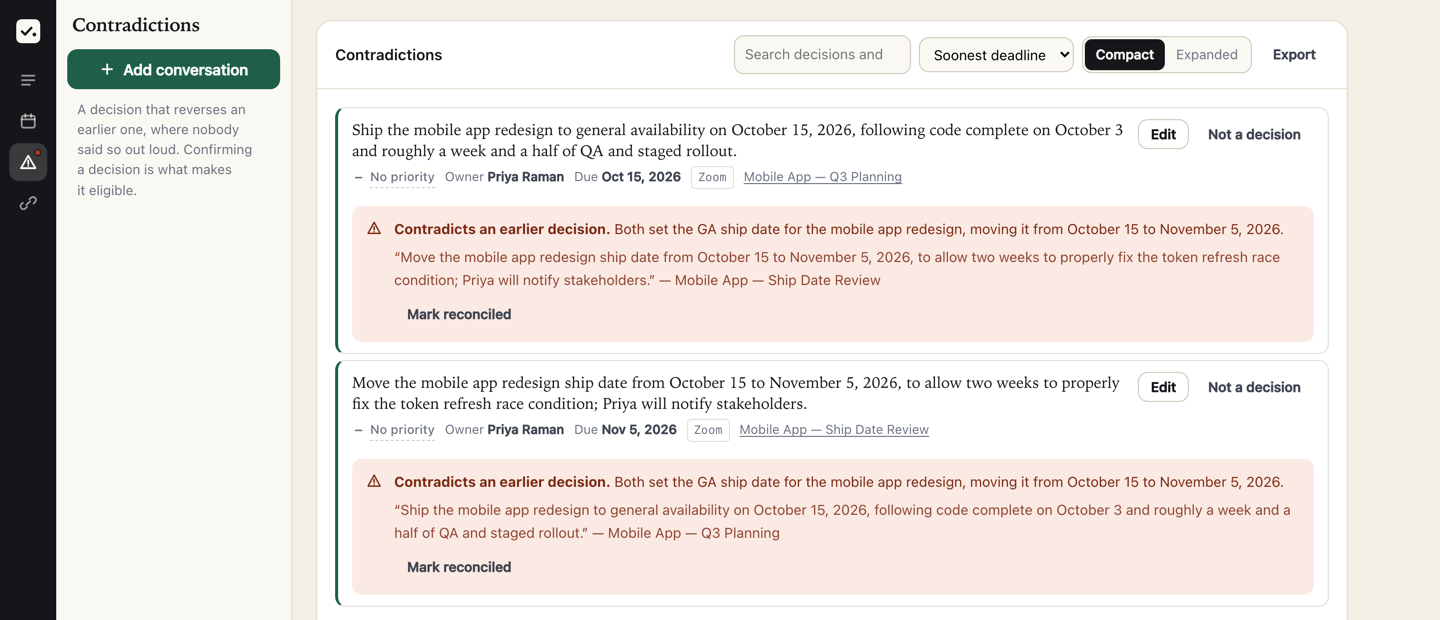
Contradicts “Ship the mobile app redesign on October 15” — decided 14 Jul in Q3 Planning. Needs review.

Switch the notifications service datastore from Postgres to DynamoDB.

Confirmed Owner Marcus Webb No deadline 0.95

In-app chat stays cut from v1 and remains in the v2 backlog.

Awaiting review Previously decided No owner recorded 0.85

Your meetings produce decisions. Your tools produce notes.

The decision to cut a feature lives in someone’s Notion page. The reversal three weeks later lives in a Slack thread. Nobody notices they contradict, the owner never hears the deadline moved, and six weeks on the same argument happens for the third time — because there was never a record to point at.

Notetakers made this worse, not better. A summary of everything said is not a record of what was settled.

How it works

Three steps, then it runs itself.

No bot joins your call. No new meeting habits. Ledger works from the transcript your platform already generates.

Upload the transcript

Drop in the .vtt from a Zoom cloud recording, a Gemini notes doc, or paste text. Ledger detects the format and normalises it.

Review what it found

Every extracted decision arrives with an owner, a deadline, a confidence score, and the exact line of transcript it came from. You accept, edit, or reject.

Get told when it changes

New decisions are checked against everything already on record. Contradictions are flagged for a human — never auto-resolved.

The part that matters

It catches the reversal you didn’t notice.

Extracting decisions is table stakes. The value is knowing when a decision you already made stops being true — and telling the person who owns it.

Semantic, not keyword

“We’re going with Postgres” and “switch the notifications store to DynamoDB” share no words. Ledger compares meaning, so a reversal phrased entirely differently still surfaces.

Tuned to catch, not to be quiet

A missed contradiction costs weeks. A false flag costs ten seconds. Ledger errs toward showing you the pair and letting you dismiss it.

Never resolved automatically

A model deciding which of two decisions is “right” would be a liability. Ledger surfaces the pair with both sources and a person chooses.

Reversed, superseded, or partly changed

A full replacement supersedes the original and links back to it. A partial change is recorded as a resolved conflict with a note, so the original still reads as the decision it was.

What you get

A record you can point at.

Every decision cites its source

Each one links to the exact span of transcript it came from. When someone disputes it, you open the line.

Owners and deadlines

Pulled only when someone actually accepted the work. No owner is recorded when nobody took it.

Confidence you can filter on

Hedged discussion scores low and routes to review. Confident extraction of ambiguity is the failure mode Ledger avoids.

Weekly digest

One email: decisions past their deadline, decisions with nobody on the hook, and conflicts waiting for a human.

Search across every meeting

Filter by owner, project, status, or date. Find what was decided about billing in March without opening six documents.

Sources

Works with what your platform already gives you.

No bot in your meeting, no browser extension, no third-party notetaker holding your recordings.

VTT

Zoom cloud recording transcript

The timestamped, speaker-labelled .vtt from your Recordings tab.

AI

Zoom AI Companion summary

Its “next steps” sections are used as hints — checked against the document, never trusted outright.

GEM

Google Meet — Gemini notes

The “Take notes for me” doc, exported or pasted.

DOC

Google Meet transcript

The raw timestamped transcript doc from the organiser’s Drive.

Your workspace admin must have cloud recording and transcription enabled — Ledger reads what those produce and can’t turn them on for you.

Security

Transcripts are sensitive. Treated that way.

Tenant isolation in the database

Every row is filtered by your organisation at the database level, not by application convention. A query that forgets to scope returns nothing rather than someone else’s data.

Private storage, encrypted at rest

Uploads live in private object storage and are never served from a public URL. They’re fetched server-side after an ownership check.

Sign-in links, not passwords

Single-use, fifteen-minute links. Nothing to reuse, leak, or store.

No model training

Your transcripts are processed to extract decisions and are never used to train models.

Delete means delete

Removing a meeting removes its transcript, its decisions, and the stored file.

Pricing

Priced per meeting, not per seat.

Everyone in your organisation should be able to read the record. Charging per seat would make that expensive on purpose.

Free

$0

10 meetings, no card required

Start free
  • Decision extraction with sources
  • Unlimited members
  • 90 days of history

Business

$149 / month

Unlimited meetings

Start free trial
  • Everything in Team
  • Audit export
  • Priority support
Questions

Reasonable objections.

Does a bot join my meetings?

No. Ledger never joins a call and never records anything. It works from the transcript Zoom or Google Meet already produces, which you upload or paste. Nothing new is listening.

How is this different from an AI notetaker?

A notetaker summarises what was said. Ledger extracts what was settled — and keeps it, so a decision made in July can be checked against one made in October. A summary has no memory across meetings; that memory is the entire point here.

What if it extracts something that isn’t a decision?

Nothing reaches your record without a human accepting it. Every extraction lands in a review queue with its confidence score and the transcript line it came from. Hedged discussion scores low precisely so it surfaces for a person rather than being asserted.

What happens to my transcripts?

They’re stored in private object storage, encrypted at rest, isolated per organisation at the database level, and never used to train models. Deleting a meeting deletes the transcript, its decisions, and the stored file.

Can it read a meeting that decided nothing?

Yes, and it will tell you so. A status update with no decisions returns an empty result rather than inventing something to justify the upload. That case is tested explicitly.

What about decisions made before we started using this?

When a meeting confirms something settled earlier — “that’s decided, two weeks instead of one” — Ledger records it and marks it as previously decided, so the date it entered the record isn’t mistaken for the date it was made.

Stop having the same argument twice.

Upload one transcript and see what your last meeting actually decided. Takes about a minute.

Start free